
Intelligent Training for Customer Service How AI Improves Skills, Consistency, and Service Quality
As Customer Service gradually moves towards global and omni-channel, enterprises' requirements for the ability of customer service teams are constantly increasing. Customer service staff not only need to deal with more complex consultation content, but also need to deal with diverse customer emotions and frequently changing product and service rules, and often need to carry out services in different countries, regions and time zones.

Against this background, it is difficult for traditional training methods to support the service needs of modern enterprises. Intelligent Training is a new training model in this environment. It helps enterprises continuously improve customer service skills, unify service standards, and support long-term talent development through AI technology.
I. What is Intelligent Training?
Intelligent Training is an AI-based customer service training method. The core goal is to systematically improve the service ability of the customer service team through automation, scenario simulation and data-driven evaluation.
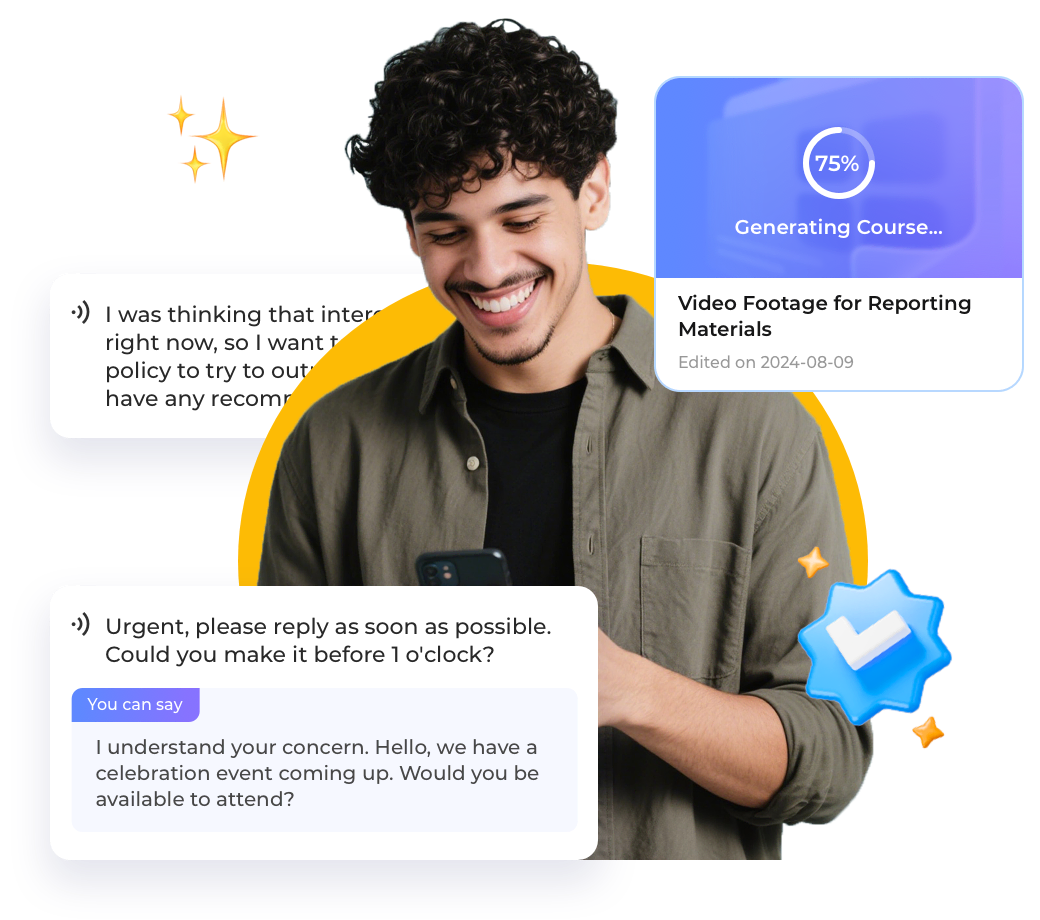
Unlike traditional training that relies on classroom teaching or static learning materials, Intelligent Training deeply integrates AI into the training process. The system can simulate real customer dialogue scenarios, evaluate the performance of customer service personnel in real time, and provide personalized feedback according to the actual service situation.
In the customer service scenario, Intelligent Training is not a one-time onboarding training, but a continuous learning system that runs through the entire service cycle of employees. From newcomers to new employees, ability improvement to long-term performance optimization, it continues to play a role.
Two. Problems faced by traditional Customer Service training
With the expansion of the service scale and the complexity of the scenario, the traditional training model gradually exposes obvious shortcomings:
Difficult to scale (Limited scalability)
Offline or centralized training requires a lot of time and organizational costs, and it is difficult to quickly cover large-scale or distributed teams.
Detachment from real scenes (Low scenario relevance)
Fixed rhetoric and theoretical explanations are difficult to restore real customer communication, especially in emotional or multi-round dialogue scenarios.
Lack of quantifiable results (Lack of measurable outcomes)
Traditional training lacks objective data support, and it is difficult for managers to evaluate the training effect or employee growth.
Slow content updates (Slow content updates)
Products, policies and business scenarios change quickly, but the training content is updated slowly, and it is easy to lag in knowledge.
These problems make it difficult for enterprises to continuously improve their customer service capabilities by relying on traditional methods alone.
III. Core Functions of Intelligent Training (Core Functions)
1. AI-Based Scenario Simulation
The Intelligent Training system can automatically generate customer service scenarios close to real business through AI, covering high-frequency problems, complex consultations and high-pressure scenarios.
Customer service staff can practice repeatedly without affecting real customers, adapt to complex conversations in advance, and greatly improve practical confidence and response ability.
2. Real-time Performance Evaluation
During the training process, AI will analyze customer service performance from multiple dimensions, including clarity, tone, accuracy, compliance and problem-solving ability.
Employees can get instant feedback during the training, instead of waiting until the training is over to summarize, so as to speed up the learning pace and improve the absorption efficiency.
3. Personalized Learning Paths
The system will automatically identify personal ability shortcomings based on training results and service data.
Then, Intelligent Training will recommend targeted courses or training scenarios to help employees focus on the skills that need to be improved the most, instead of repeating low-value learning.
4. Continuous Skill Reinforcement
Intelligent Training supports fragmented and continuous learning, not periodic centralized training.
Customer service staff can complete short-term training between work, continuously consolidate skills, and quickly adapt to new service rules or product changes.
5. Training Analytics and Management Visualization
The system helps managers to fully grasp the training progress, the trend of ability change and the overall status of the team by visualizing the Dashboard.
These data provide a clear basis for coaching, staffing and service optimization, so that the training is truly aligned with business goals.
IV. The role of Intelligent Training in Customer Service operation
In the real Customer Service scenario, Intelligent Training is more like a part of daily operations than an independent training module.
For example, the training content can be directly developed around the recent high-frequency complaints, the launch of new products or the update of compliance requirements to ensure that the training is always in line with the actual business.
In the global service team, Intelligent Training can also take into account the language and cultural differences in different regions while unifying service standards.
V. The role of Instadesk Intelligent Training
Instadesk Intelligent Training is an important part of the Instadesk customer service system, focusing on the systematic cultivation of customer service capabilities.
It integrates AI simulation, performance evaluation and skill analytics into the same platform to help enterprises build sustainable and scalable Customer Service training. Training system.
Instadesk Intelligent Training is not a substitute for manual training, but provides clearer data support and more efficient training tools for managers and trainers.
VI. The value brought by Intelligent Training to enterprises
By introducing Intelligent Training, enterprises can get multi-faceted benefits:
• Faster new employee onboarding
• Consistent service standards across regions and teams
• Reduce training costs and improve training efficiency
• Reduce customer complaints caused by communication problems
• Support the long-term ability growth of customer service staff
These values make Intelligent Training a long-term strategic capability rather than a short-term tool.
Conclusion
In the era when Customer Experience has become the core competitiveness, the training method itself also needs to be upgraded. Intelligent Training provides enterprises with a sustainable and large-scale customer service capacity-building path.
Through AI-driven scenario simulation, ability assessment and personalized learning, enterprises can achieve the continuous growth of the customer service team while maintaining high service standards.
The solution represented by Instadesk Intelligent Training is helping enterprises transform customer service training from "cost input" to "long-term value assets".
Tags
Share This Article



Issac
Omnichannel Digital Operations: Driving Traffic Growth & Deepening User Value
You may also like

Resolving Enterprise Training Pain Points: Instadesk Delivers Personalized 1-on-1 AI Coaching
Enterprise training often struggles with slow onboarding, high costs and unquantifiable effects—until Instadesk’s Intelligent Training changes the game. Centered on real-scenario 1v1 coaching, Instadesk's Intelligent Training delivers instant feedback and empowers teams to turn practice into performance fast.


Corporate Training Platform: A Guide for Enterprise Learning and Development
A corporate training platform delivers, manages, and tracks employee learning, with modern versions featuring AI simulation, personalized paths, and HR integration. It solves traditional training flaws, boosts enterprise efficiency, and Instadesk’s platform offers AI roleplay, real-time feedback, and proven results like 40% faster onboarding.


Corporate Training Courses for Insurance: A Guide for Insurers
AI-powered corporate training courses address insurance companies’ training challenges by replacing passive traditional methods with realistic simulations, real-time feedback, and measurable progress. Instadesk’s Intelligent Training platform offers insurance-specific scenarios, accelerating agent onboarding, boosting sales, and reducing compliance risks.
Get Started in Minutes. Experience the Difference.




WhatsApp Us Now !